Version 34.0 (AppSource Version 1030)
BI for Intune Version 34.0, shown as version 1030 in AppSource, was released on March 4, 2024.
This version introduces our Enhanced Inventory for macOS.
Below Are The Changes in Version 34.0
- Features:Custom inventory for macOS. See below for details.A new field "App Inventory Install Path" has been added for MacOS Enhancements:
- Optimized code for faster refresh times when large number of drivers are approved. Bug Fixes:
- N/A Important Notes:
- Always backup your custom reports using our backup process.
Introducing Enhanced Inventory for macOS
We have been using PowerShell to collect information that Intune does not natively collect from Windows devices for quite a while. Most customers using a remediation script as a method to schedule the script to run on a reoccurring basis. We are now doing the same for macOS using a bash script. We created this script at the request of a customer. It collects the installed software from macOS and sends that to Log Analytics just like our PowerShell script does on Windows. You can deploy the script as a Shell script from Intune. Ideally the script should be run once per day on each device. This way any changes to the device get captured.
Below is the inventory script for macOS. Make sure you configure the CustomerID and SharedKey according to our documentation here.
Batch
#!/bin/bash
# Replace with your Log Analytics Workspace ID
CustomerId=""
# Replace with your Primary Key
SharedKey=""
#Control if you want to collect App or Device Inventory or both (True = Collect)
CollectDeviceInventory=false
CollectAppInventory=true
# You can use an optional field to specify the timestamp from the data. If the time field is not specified, Azure Monitor assumes the time is the message ingestion time
# DO NOT DELETE THIS VARIABLE. Recommened keep this blank.
TimeStampField=""
#endregion initialize
#region functions
# Function to create the authorization signature
# function New-Signature ($customerId, $sharedKey, $date, $contentLength, $method, $contentType, $resource) {
function New-Signature() {
    customerId=$1
    sharedKey=$2
    date=$3
    contentLength=$4
    method=$5
    contentType=$6
    resource=$7
    xHeaders="x-ms-date:$date"
    stringToHash="$methodn$contentLengthn$contentTypen$xHeadersn$resource"
    # Convert the message and secret to bytes
    bytesToHash=$(echo -ne "$stringToHash" | xxd -p -u -c 256)
    keyBytes=$(echo "$sharedKey" | base64 -d | xxd -p -u -c 256)
    # Calculate HMAC-SHA256
    calculatedHash=$(echo -n "$bytesToHash" | xxd -r -p | openssl dgst -sha256 -mac HMAC -macopt hexkey:$keyBytes -binary | base64)
    authorization=$(echo "SharedKey" $customerId:$calculatedHash)
    echo $authorization
}
# Function to create and post the request
# Function Send-LogAnalyticsData($customerId, $sharedKey, $body, $logType)
function Send-LogAnalyticsData() {
    customerId=$1
    sharedKey=$2
    body=$3
    logType=$4
    method="POST"
    contentType="application/json"
    resource="/api/logs"
    rfc1123date=$(date -u +%a, %d %b %Y %H:%M:%S GMT)
    #contentLength=${#body}
    bodyEncoded=$(echo -n "$body" | iconv -f UTF-8 -t WINDOWS-1252 | iconv -f WINDOWS-1252 -t UTF-8)
    contentLength=$(echo -n "$bodyEncoded" | wc -c | tr -d '[:space:]')
    signature=$(New-Signature "$customerId" "$sharedKey" "$rfc1123date" "$contentLength" "$method" "$contentType" "$resource")
    uri="https://$customerId.ods.opinsights.azure.com$resource?api-version=2016-04-01"
    # Define the maximum payload size limit in bytes
    max_payload_size=$(echo -n "scale=2; 31.9 * 1024 * 1024" | bc)
    # Calculate the payload size in bytes
    payload_size=$(echo "scale=2; $(echo -n "$body"| wc -c)"| bc)
    # Convert the payload size to megabytes with one decimal place
    payload_size_mb=$(echo -n "scale=2; $payload_size / 1024 / 1024" | bc)
    # Check if the payload size exceeds the limit
    if [ $(bc -l <<< "$payload_size > $max_payload_size") -eq 1 ]; then
        statusmessage="Upload payload is too big and exceeds the 32Mb limit for a single upload. Please reduce the payload size. Current payload size is: $payload_size_mb Mb"
    else
        payloadsize_kb=$(echo "Upload payload size is " $(echo "scale=2; $(echo -n "$body"| wc -c)/ 1024"| bc)"Kb")
        response=$(curl --location "$uri" -w "%{http_code}" --header "Authorization: $signature" --header "Log-Type: $logType" --header "x-ms-date: $rfc1123date" --header "time-generated-field;" --header "Content-Type: $contentType" --data "$body" --silent)
        statusmessage="$response : $payloadsize_kb"
    fi
    echo $statusmessage
}
#endregion functions
#region script
#Get Common data for App and Device Inventory:
#Get Intune DeviceID and ComputerName
# Retrieve Intune DeviceID
ManagedDeviceID=$(security find-certificate -a | awk -F= '/issu/ && /MICROSOFT INTUNE MDM DEVICE CA/ { getline; gsub(/"/, "", $2); print $2}' | head -n 1)
# Retrieve ComputerName
ComputerName=$(scutil --get ComputerName)
#region APPINVENTORY
if [ "$CollectAppInventory" = true ]; then
    #Set Name of Log
    AppLog="PowerStacksAppInventory"
    #installedApps=$(Get-InstalledApplications)
    installedApps=$(system_profiler SPApplicationsDataType -json)
    # Use awk to parse JSON data and extract fields
    InstalledAppJson=$(echo "$installedApps" | awk -F'[:,]' '
        $1 ~ /_name/ {
            name = $2
            gsub(/"/, "", name)
            gsub(/^[[:space:]]+|[[:space:]]+$/, "", name)
        }
        $1 ~ /lastModified/ {
            lastModified = $0
            sub(/.*: /, "", lastModified)
            gsub(/"/, "", lastModified)
            gsub(/,$/, "", lastModified)
            gsub(/^[[:space:]]+|[[:space:]]+$/, "", lastModified)
        }
        $1 ~ /path/ {
            path = $2
            gsub(/"/, "", path)
            gsub(/^[[:space:]]+|[[:space:]]+$/, "", path)
        }
        $1 ~ /version/ {
            version = $2
            gsub(/"/, "", version)
            gsub(/^[[:space:]]+|[[:space:]]+$/, "", version)
            print "{"AppName":"" name "","AppVersion":"" version "","AppInstallDate":"" lastModified "","AppInstallPath":"" path ""}"
        }
    ' | paste -sd "," -)
    # Encode to UTF-8, compress, and then encode to base64
    InstalledAppJson=$(echo -n "[$InstalledAppJson]" | iconv -t utf-8 | gzip -c -n | base64 | tr -d 'n')
    # Define chunk size
    chunk_size=31744
    # Split the string into chunks and store in an array
    InstalledAppJsonArr=()
    while [ -n "$InstalledAppJson" ]; do
        chunk=$(echo "$InstalledAppJson" | cut -c 1-$chunk_size)
        InstalledAppJsonArr+=("$chunk")
        InstalledAppJson=$(echo "$InstalledAppJson" | cut -c $(($chunk_size + 1))-)
    done
    # Print each chunk
    i=0
    InstalledApps=""
    for chunk in "${InstalledAppJsonArr[@]}"; do
        i=$(echo $i + 1 | bc)
        if [ "$i" == "1" ]; then
            InstalledApps=$(echo ""InstalledApps$i":"$chunk"")
        else
            InstalledApps="$InstalledApps,$(echo ""InstalledApps$i":"$chunk"")"
        fi
    done
    #echo $InstalledApps
    # Define the maximum installapps size limit in bytes
    max_installapps_size=$(echo -n "scale=2; 10.0 * 31 * 1024" | bc)
    #max_installapps_size=$((1 * 1 * 1))
    # Calculate the installapps size in bytes
    installapps_size=$(echo "scale=2; $(echo -n "$InstalledApps"| wc -c)"| bc)
    # Convert the installapps size to kilobytes with one decimal place
    installapps_size_kb=$(echo -n "scale=2; $installapps_size / 1024" | bc)
    if [ $(bc -l <<< "$installapps_size > $max_installapps_size") -eq 1 ]; then
        echo "InstalledApp is too big and exceed the 32kb limit per column for a single upload. Please increase number of columns (#10). Current payload size is: $installapps_size_kb kb"
        exit 1
    fi
    MainApp="[{"ComputerName":"$ComputerName","ManagedDeviceID":"$ManagedDeviceID",$InstalledApps}]"
    ResponseAppInventory=$(Send-LogAnalyticsData "$CustomerId" "$SharedKey" "$MainApp" "$AppLog")
fi
#endregion APPINVENTORY
#Report back status
# Get current date in the specified format
date=$(date -u +"%d-%m %H:%M")
# Initialize output message
output_message="InventoryDate: $date"
# Check CollectDeviceInventory flag
if [ "$CollectDeviceInventory" = true ]; then
    # Check response for DeviceInventory
    if [[ "$ResponseDeviceInventory" =~ "200 :" ]]; then
        output_message="$output_message DeviceInventory: OK $ResponseDeviceInventory"
    else
        output_message="$output_message DeviceInventory: Fail - $ResponseDeviceInventory"
        exit 1
    fi
fi
# Check CollectAppInventory flag
if [ "$CollectAppInventory" = true ]; then
    # Check response for AppInventory
    if [[ "$ResponseAppInventory" =~ "200 :" ]]; then
        output_message="$output_message AppInventory: OK $ResponseAppInventory"
    else
        output_message="$output_message AppInventory: Fail - $ResponseAppInventory"
        exit 1
    fi
fi
echo "$output_message"
exit 0
#endregion script
#!/bin/bash
Replace with your Log Analytics Workspace ID
CustomerId="
Replace with your Primary Key
SharedKey="
Control if you want to collect App or Device Inventory or both (True = Collect)
CollectDeviceInventory=false CollectAppInventory=true
You can use an optional field to specify the timestamp from the data. If the time field is not specified, Azure Monitor assumes the time is the message ingestion time
DO NOT DELETE THIS VARIABLE. Recommened keep this blank.
TimeStampField=""
endregion initialize
region functions
Function to create the authorization signature
function New-Signature ($customerId, $sharedKey, $date, $contentLength, $method, $contentType, $resource) {
function New-Signature() { customerId=$1 sharedKey=$2 date=$3 contentLength=$4 method=$5 contentType=$6 resource=$7 xHeaders="x-ms-date:$date" stringToHash="$methodn$contentLengthn$contentTypen$xHeadersn$resource" # Convert the message and secret to bytes bytesToHash=$(echo -ne "$stringToHash" | xxd -p -u -c 256) keyBytes=$(echo "$sharedKey" | base64 -d | xxd -p -u -c 256) # Calculate HMAC-SHA256 calculatedHash=$(echo -n "$bytesToHash" | xxd -r -p | openssl dgst -sha256 -mac HMAC -macopt hexkey:$keyBytes -binary | base64) authorization=$(echo "SharedKey" $customerId:$calculatedHash) echo $authorization }
Function to create and post the request
Function Send-LogAnalyticsData($customerId, $sharedKey, $body, $logType)
function Send-LogAnalyticsData() { customerId=$1 sharedKey=$2 body=$3 logType=$4 method="POST" contentType="application/json" resource="/api/logs" rfc1123date=$(date -u +%a, %d %b %Y %H:%M:%S GMT) #contentLength=${#body} bodyEncoded=$(echo -n "$body" | iconv -f UTF-8 -t WINDOWS-1252 | iconv -f WINDOWS-1252 -t UTF-8) contentLength=$(echo -n "$bodyEncoded" | wc -c | tr -d '[:space:]') signature=$(New-Signature "$customerId" "$sharedKey" "$rfc1123date" "$contentLength" "$method" "$contentType" "$resource") uri="https://$customerId.ods.opinsights.azure.com$resource?api-version=2016-04-01" # Define the maximum payload size limit in bytes max_payload_size=$(echo -n "scale=2; 31.9 * 1024 * 1024" | bc) # Calculate the payload size in bytes payload_size=$(echo "scale=2; $(echo -n "$body"| wc -c)"| bc) # Convert the payload size to megabytes with one decimal place payload_size_mb=$(echo -n "scale=2; $payload_size / 1024 / 1024" | bc) # Check if the payload size exceeds the limit if [ $(bc -l <<< "$payload_size > $max_payload_size") -eq 1 ]; then statusmessage="Upload payload is too big and exceeds the 32Mb limit for a single upload. Please reduce the payload size. Current payload size is: $payload_size_mb Mb" else payloadsize_kb=$(echo "Upload payload size is " $(echo "scale=2; $(echo -n "$body"| wc -c)/ 1024"| bc)"Kb") response=$(curl --location "$uri" -w "%{http_code}" --header "Authorization: $signature" --header "Log-Type: $logType" --header "x-ms-date: $rfc1123date" --header "time-generated-field;" --header "Content-Type: $contentType" --data "$body" --silent) statusmessage="$response : $payloadsize_kb" fi echo $statusmessage }
endregion functions
region script
Get Common data for App and Device Inventory:
Get Intune DeviceID and ComputerName
Retrieve Intune DeviceID
ManagedDeviceID=$(security find-certificate -a | awk -F= '/issu/ && /MICROSOFT INTUNE MDM DEVICE CA/ { getline; gsub(/"/, "", $2); print $2}' | head -n 1)
Retrieve ComputerName
ComputerName=$(scutil --get ComputerName)
region APPINVENTORY
if [ "$CollectAppInventory" = true ]; then #Set Name of Log AppLog="PowerStacksAppInventory" #installedApps=$(Get-InstalledApplications) installedApps=$(system_profiler SPApplicationsDataType -json) # Use awk to parse JSON data and extract fields InstalledAppJson=$(echo "$installedApps" | awk -F'[:,]' ' $1 ~ /_name/ { name = $2 gsub(/"/, "", name) gsub(/^[[:space:]]+|[[:space:]]+$/, "", name) } $1 ~ /lastModified/ { lastModified = $0 sub(/.*: /, "", lastModified) gsub(/"/, "", lastModified) gsub(/,$/, "", lastModified) gsub(/^[[:space:]]+|[[:space:]]+$/, "", lastModified) } $1 ~ /path/ { path = $2 gsub(/"/, "", path) gsub(/^[[:space:]]+|[[:space:]]+$/, "", path) } $1 ~ /version/ { version = $2 gsub(/"/, "", version) gsub(/^[[:space:]]+|[[:space:]]+$/, "", version) print "{"AppName":"" name "","AppVersion":"" version "","AppInstallDate":"" lastModified "","AppInstallPath":"" path ""}" } ' | paste -sd "," -) # Encode to UTF-8, compress, and then encode to base64 InstalledAppJson=$(echo -n "[$InstalledAppJson]" | iconv -t utf-8 | gzip -c -n | base64 | tr -d 'n') # Define chunk size chunk_size=31744 # Split the string into chunks and store in an array InstalledAppJsonArr=() while [ -n "$InstalledAppJson" ]; do chunk=$(echo "$InstalledAppJson" | cut -c 1-$chunk_size) InstalledAppJsonArr+=("$chunk") InstalledAppJson=$(echo "$InstalledAppJson" | cut -c $(($chunk_size + 1))-) done # Print each chunk i=0 InstalledApps="" for chunk in "${InstalledAppJsonArr[@]}"; do i=$(echo $i + 1 | bc) if [ "$i" == "1" ]; then InstalledApps=$(echo ""InstalledApps$i":"$chunk"") else InstalledApps="$InstalledApps,$(echo ""InstalledApps$i":"$chunk"")" fi done #echo $InstalledApps # Define the maximum installapps size limit in bytes max_installapps_size=$(echo -n "scale=2; 10.0 * 31 * 1024" | bc) #max_installapps_size=$((1 * 1 * 1)) # Calculate the installapps size in bytes installapps_size=$(echo "scale=2; $(echo -n "$InstalledApps"| wc -c)"| bc) # Convert the installapps size to kilobytes with one decimal place installapps_size_kb=$(echo -n "scale=2; $installapps_size / 1024" | bc) if [ $(bc -l <<< "$installapps_size > $max_installapps_size") -eq 1 ]; then echo "InstalledApp is too big and exceed the 32kb limit per column for a single upload. Please increase number of columns (#10). Current payload size is: $installapps_size_kb kb" exit 1 fi MainApp="[{"ComputerName":"$ComputerName","ManagedDeviceID":"$ManagedDeviceID",$InstalledApps}]" ResponseAppInventory=$(Send-LogAnalyticsData "$CustomerId" "$SharedKey" "$MainApp" "$AppLog") fi
endregion APPINVENTORY
Report back status
Get current date in the specified format
date=$(date -u +"%d-%m %H:%M")
Initialize output message
output_message="InventoryDate: $date"
Check CollectDeviceInventory flag
if [ "$CollectDeviceInventory" = true ]; then # Check response for DeviceInventory if [[ "$ResponseDeviceInventory" =~ "200 :" ]]; then output_message="$output_message DeviceInventory: OK $ResponseDeviceInventory" else output_message="$output_message DeviceInventory: Fail - $ResponseDeviceInventory" exit 1 fi fi
Check CollectAppInventory flag
if [ "$CollectAppInventory" = true ]; then # Check response for AppInventory if [[ "$ResponseAppInventory" =~ "200 :" ]]; then output_message="$output_message AppInventory: OK $ResponseAppInventory" else output_message="$output_message AppInventory: Fail - $ResponseAppInventory" exit 1 fi fi echo "$output_message" exit 0
endregion script
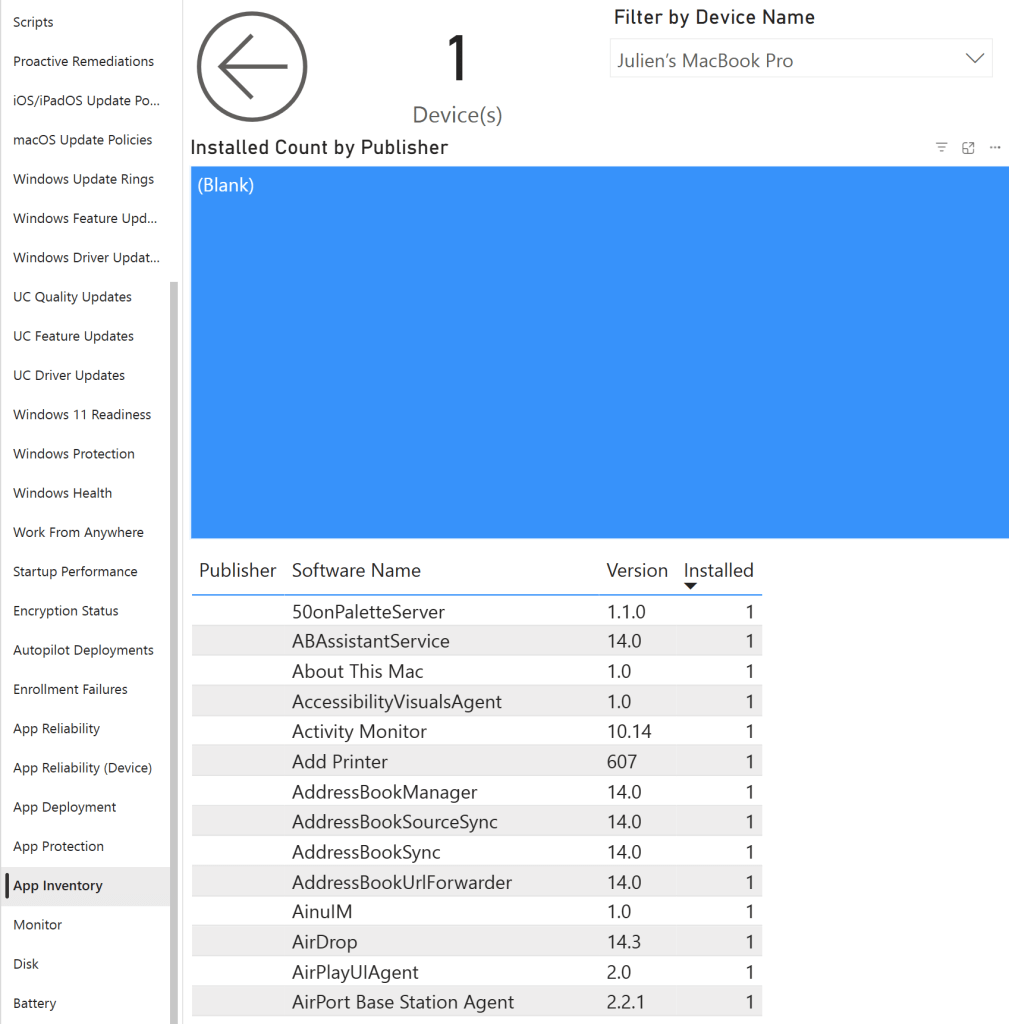
The App Inventory Page Will Display Apps Installed on macOS